10 October 2020 – Some focused time with the benchwork and control panel
In an unexpected turn of events, my full-time employment ended as part of a reduction in force. This yielded some uninterrupted time to work on the layout for the past month and progress improved tremendously. Benchwork and a brand new control panel at Iron Mountain are the results so far.

The first step was to prepare the benchwork to support the fascia from Antoine to Powers and Felch Jct. which is where the railroad will disappear behind the water heater. The routes split four ways at this point. The ore line can be switched to the ore yard and ore dock or bypass that for Escanaba (staging). The main line can be switched to go to Escanaba or directly to Green Bay. This loosely follows the prototype in 1962.


The panel must be cut to receive the panel. There is also a Digitrax outlet next to the panel. A car card box will also be installed here.

The Fascia is painted to match the rest of the room.

The panel at Antoine is where the new fascia begins. The logos for the Milwaukee Road and the CNW are wood cuts that I’ve had for years. Nice to finally have a place where they belong!

The car card box is installed. I modify these to hold bamboo skewers that are very good for uncoupling cars. Most of the sidings have uncoupling magnets below the track bed, but it doesn’t hurt to prepare for the worst.

The control panel for Iron Mountain has been prepared in the photo above. This panel was challenging because it shares control with the panel at Antoine for many of the turnouts. This was accomplished by creating new JMRI inputs for the pushbuttons at Iron Mountain, but sharing the outputs from previously deployed Digitrax DS64s. I presented to the Michiana Division of the National Model Railroad Association (NMRA) on this topic in April 2020. One of these days I will post the presentation here.
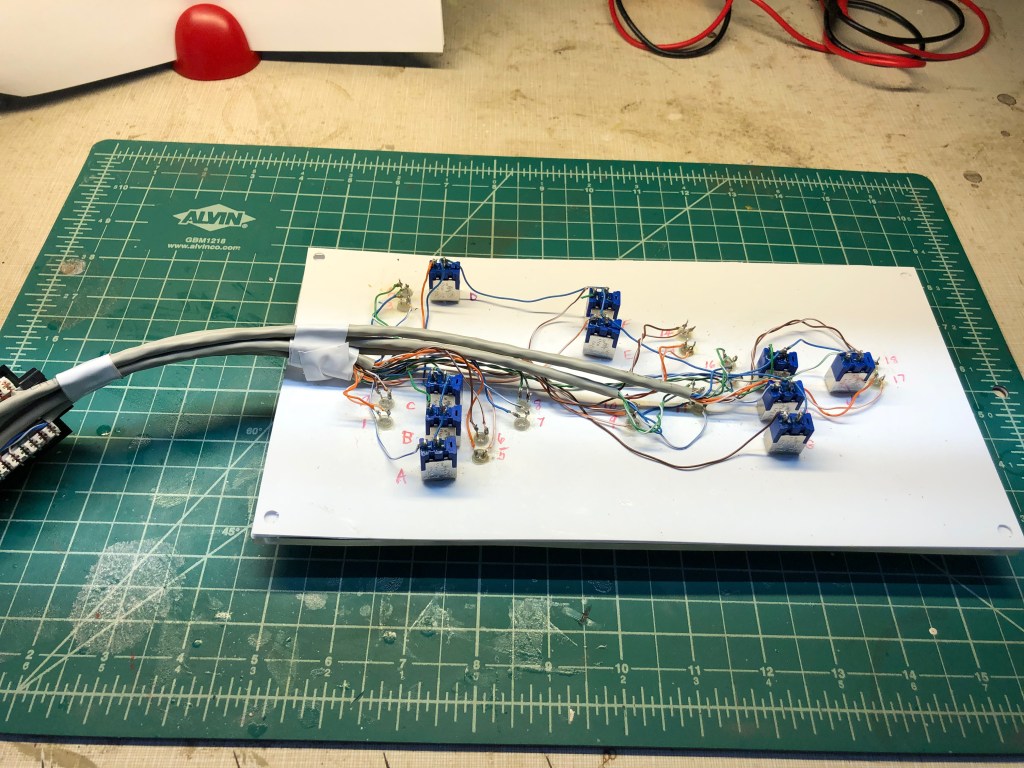
The photo above shows the completed wiring on the back of the panel. Each pushbutton and LED are labeled. Ethernet cable is used to connect each wire to a punchdown block. This makes connecting the wires on the layout easier and also allows for the panel to be removed for maintenance if necessary.
The layout has 45 tortoise machines installed to date and each of them are controlled by a pushbutton on a control panel. There will be close to 70 installed when the layout is complete. The aspect of the tortoise machine and the turnout it controls is shown on the control panel by dual bulb LEDs that show green or red based on the polarity of the signal coming across the led from the DS64 to the Tortoise machine. I have installed at least 100 LEDs on the layout. Last week I finally found a bad one. The red/green LEDs actually contain two circuits which are directional based on polarity. That little problem cost me a couple of hours as I tested and retested every connection. I finally decided to replace the LED and that was the problem. Nobody is perfect.

Shown above is the panel at Iron Mountain. It works just as it was designed to work in conjunction with the panel at Antoine. This will allow two operators to work together over this stretch of the railroad without needing one to ask the other to throw a turnout. Both operators will be able to see the aspect of every turnout that impacts their work. It will require that operators be aware that these turnouts may be thrown from the other panel.

There is still much to do to complete the railroad to Powers and Felch Junction, but the track, control panels, turnouts, and fascia are complete. The next project will be to complete the drywall and framing to hide the water heater and build the benchwork to support the ore yard which leads to the ore dock. Stay tuned!
 Uncle Heavy's Michigan Ore Lines